







Antinous The Gay God
Antinous drowned in the Nile river in October of the year 130. The local people of Egypt indicated that Antinous had become a sacred being...they believed that all those who drowned in the Nile had been embraced by Osiris, that the drowned person would become Osiris, rising up from the underworld to live forever as an immortal, and that through their death, the Inundation of the Nile would be assured. The Greek philosophers hearing that Antinous had become a local demigod brought the news to Hadrian, assuring him that as the living God-King, Pharoah and Divine Emperor of Rome, the years that had been taken away from Antinous were now added to his own life. Hadrian responded by issuing a declaration, that a New God had arisen from the Nile. Hadrian decreed that Antinous was to be numbered among the gods and heroes of the Roman Religion.
Temples were dedicated to Antinous, and a new cult was ordained to serve his worshipers. The center of this cult was the city of Antinoopolis where Antinous died, but many other cities, mostly in the Greek provinces also built Temples, and there were private shrines dedicated to Antinous everywhere, from Britania, to the Danube Frontier to North Africa. Priests of Antinous were appointed to perform the ceremonies that would perpetuate the memory of the New God Antinous for all eternity.
Athletic games were celebrated in the major centers of his religion, such as Antinoopolis, Bithynia, and Mantinea. The competitors were primarily young men called Ephebes. In Antinoopolis these included swimming and boat races in the Nile, but the Antinous Games were unique in that they also included competition in the arts and music. The over-all winner was consecrated as the living embodiment of Antinous and given citizenship in Antinoopolis, with an all-expense-paid life of luxury and adoration. He was worshiped in the temple as the representative of Antinous, the emblem of youth and masculinity. He was the Divine Ephebe.
The gentle gay religion of Antinous was the last manifestation of the ancient pagan faith. It summoned the glories of the past in final triumph, and was also a religion of individual salvation, reflecting the spiritual changes that were taking place as Christianity and the other eastern mystery faiths gained strength. Antinous was the Last God of ancient Rome, and he was also unfortunately used as a weapon against the pagans by the Catholic faith. The Christians found an easy target in the supposedly questionable moral message that Antinous embodied. They used him as an example to illustrate that the Roman Religion had become a religion of pederasty, immoral sexual indulgence, and idolatry. The small cult of Antinous was always at the forefront of controversy between the pagans and the early Christians, primarily because of overtly homosexual elements of Antinous, but also because his religion was spoken of as comparable to Christianity in many ways by more traditional pagans, because of the salvation and blessing that Antinous bestowed upon his worshipers.
Antinous was compared to the boy gods who had given their lives for the benefit of mankind. Among them the Egyptian Osiris, Hermes the messenger, and Dionysus god of the vine whose homosexuality had always been celebrated for a thousand years in Greece. Also Ganymede, the beautiful boy whom the great god Jupiter had taken to be his lover, and the cup bearer of heaven, the young deity who served the cup of immortality to the gods. Jupiter had swept down upon Ganymede in the form of an eagle and carried him to Olympus, just as Hadrian whose symbol as Emperor was the eagle, had swept down upon Antinous and carried him to world-wide fame.
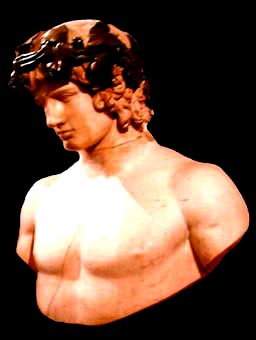
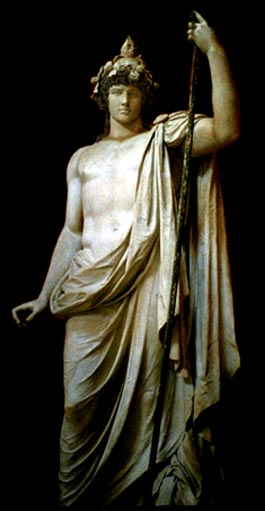
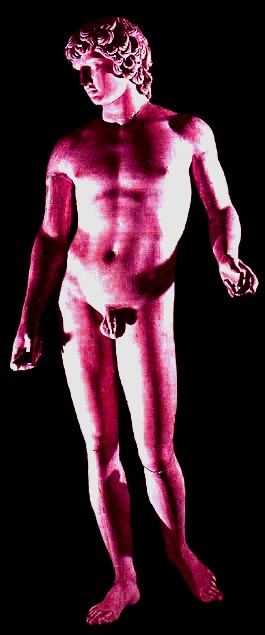
Under Hadrian's direction, statues of Antinous were fashioned, using models that had been carved while Antinous was still alive. These statues often portrayed Antinous in the costume and symbols of the famous beautiful boy-gods, but many show Antinous without divine attributes, suggesting that Antinous was a new unprecedented God. These statues were set up everywhere in the Empire within the official Temples of Antinous, and in private shrines within the homes of his worshipers. Hundreds remain and can be found in the great museums of the world. Looking upon them, one is struck by their beauty and by their astonishing similarity. They are so perfect that they are like photographs, revealing the true, unmistakable image of what Antinous looked like in life. There is no god in the world whose face is so well captured. And it is for this reason that Beauty is among the most important spiritual elements of his faith. His beauty was so extraordinary that it was crucial that it be captured and replicated with exactitude. Over the centuries his beauty has astonished and captivated all those who look upon him, leaving a deep impression of godliness within the soul.
The religion of Antinous lasted several hundred years, well into the Christian era, but it suffered severe persecution and was eventually eradicated. It is significant to note that when the cult of Antinous was denounced and his images smashed by the iconoclasts, the peace and stability of Rome went into decline. Hadrian had blessed the Empire with a gentle protector, who gave her prosperity and grace. When the Empire turned against her vulnerable guardian, the way was open for chaos and destruction.
The extraordinary story of Antinous was preserved by the Church in
documents denouncing paganism. The beautiful images of Antinous were
often carefully buried underground by his worshipers to protect them
from the destruction, eventually, hundreds of years later, the statues
were discovered and were seen as absolute treasures from the ancient
age. One colossal head of Antinous even being described as the greatest
achievement of ancient art.
And now, in this day, as the Gay Spirit is returning to the world
again without fear of death and violence, we find that Antinous has
come again. His statues and Temples are uncovered , and his star is
again shinning, but what is more significant is that here in this
New Gay Religion, and in the hearts of homosexual men all over the
world, his gentle spirit is rising up from the vineyards where long
ago, the last priests buried his image, in expectation and hope for
better days....the hope and the dream of the ancients is coming into
being...Gay Rights are now one of the most important social issues
in the world, this is what Antinous has always stood for, what he
represented in the ancient sense, and what he means now..that Antinous,
although he is a God, was once a living human being, as real and as
beautiful as any of us, and like Antinous, we are all immortal beings
capable of becoming gods, that homosexuality is a sacred state of
being, that it is a form of Love and all forms of Love are sacred
and beautiful and worthy of our highest devotion and reverence. Antinous
is the God of all Gay people, he was a homosexual, and it is therefore
our calling as gay men to restore his name and the place of his religion
to the reverence of his ancient past.
Hadrian deified Antinous because he loved him, because he wanted to give Antinous everything that he had within his power to bestow upon Antinous. Hadrian inaugurated the ancient religion of Antinous as a way of asking other gay men to remember Antinous and ensure that his name would never be forgotten and that his beauty and his gentle heart would never fade away. For centuries, Hadrian's request was enthusiastically granted by ancient gay men and people in general, who worshiped Antinous with deep devotion, long, long after Hadrian and his successors. The name and beauty of Antinous fascinated people, throughout history, especially gay men. And now the beautiful mystery of Antinous has been given to us, to the Modern Gay Community. It is therefore our duty (for those who choose to take his image upon their shoulders) in answer to the request of Hadrian, for the world, for gay men, to remember Antinous, to perpetuate his name, and to love him for all eternity, as Hadrian loved him.
This is the deepest foundation of
the Modern Religion of Antinous...to hear the call of Hadrian across
the centuries, to love, worship and care for the memory of the beautiful
Antinous, because without us, the Name of Antinous could vanish into
oblivion, or else he could merely languish on a shelf in a museum
without anyone to ever say:
Behold the Divine Antinous
May He live Forever!